Before You Throw It Away
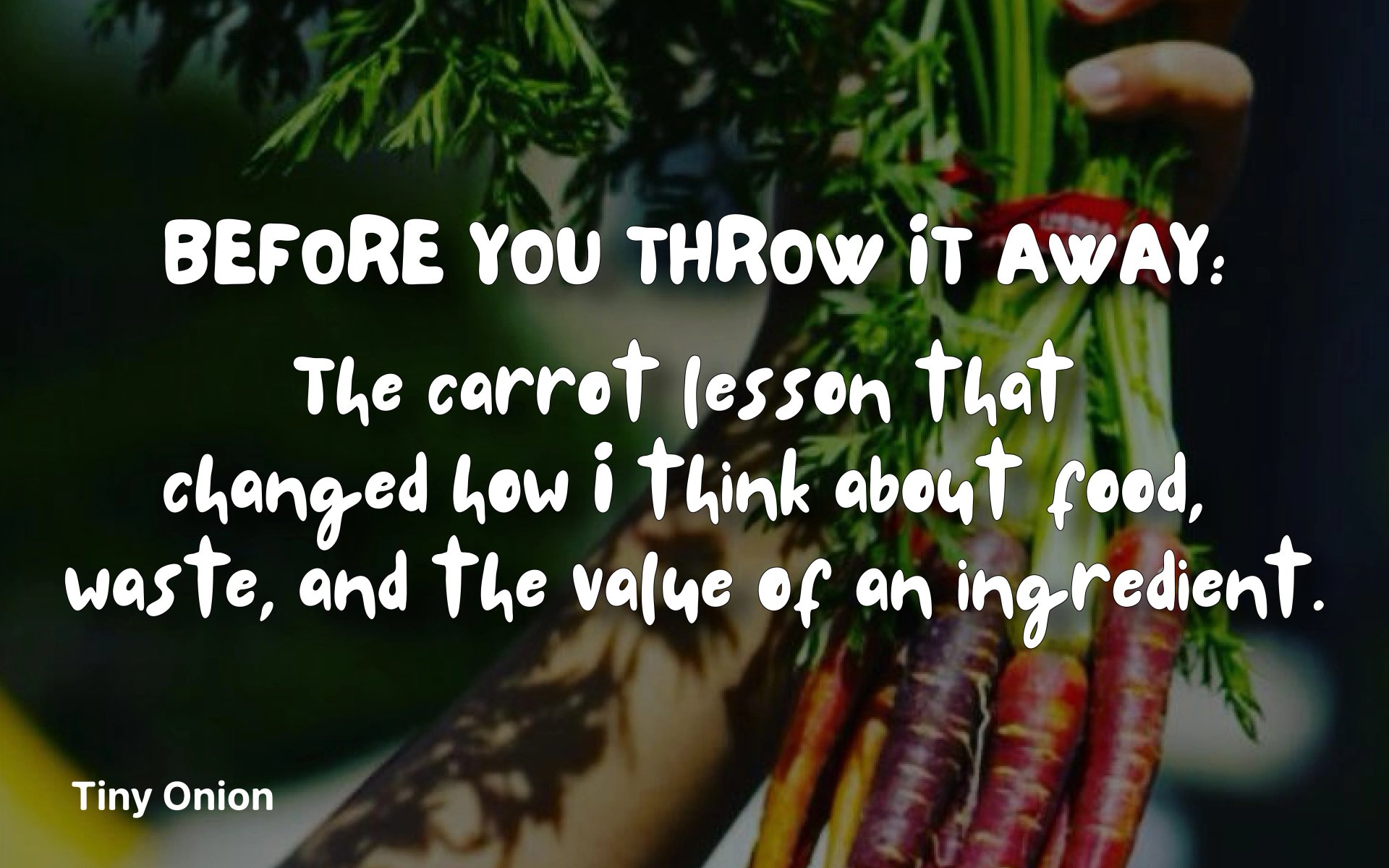
Many years ago, I was working in a five-diamond hotel under a chef who is still a mentor of mine today.
I was preparing a platter with peeled baby carrots, and a few had some brown spots. Nothing was actually wrong with them, but in my mind, they weren’t pristine enough for what I was making. So I put them to the side, intending to give them to the staff caf. That was where we put food that was extra from buffets, overprepping, and other kitchen leftovers. I didn’t think twice about it.
My chef did.
He saw me from his office and very loudly let me know I had made the wrong decision. Then came the lesson. Find out how much the carrots cost, how many I had set aside, and what I could have done with them instead.
Could I trim them? Use them in soup, a purée, or stock? Find another dish where their appearance didn’t matter?
At the time, he was teaching me about food cost. But what I took away was something much bigger.
Just because an ingredient isn’t right for one use doesn’t mean it has no value.
I Still Think About Those Carrots
More than two decades later, I can still picture them. Somewhere along the way, that lesson stopped being only about money.
The longer I’ve worked with food, the more I’ve come to appreciate everything that happens before an ingredient reaches my cutting board. Someone grew it. There was soil, water, labor, time, transportation, and energy behind it. And when you know some of the farmers and growers responsible for that food, and recognize that access to fresh, quality ingredients isn’t a reality for everyone, it becomes even harder to see food as disposable simply because it isn’t perfect.
These days, my first question isn’t, Should I throw this away? It’s, What else can this become?
Before the Compost Bin
Composting is great, and I believe in it. But before something gets there, I want to know if we can eat it.
Carrot peels can be pickled. Beet skins can be seasoned and oven-dried until crisp. Onion skins can be dried and ground into a flavorful powder. Vegetable scraps can become the foundation for tomorrow’s soup or stew.
And sometimes we create waste before we even have scraps.
We trim too much.
I see it all the time. A big piece gets cut from the top of a carrot or green bean because of a tiny stem. Too much of an onion disappears with the root. A perfectly good piece of tomato goes with the core.
Remove what actually needs to go. Keep the rest.
It sounds small, but multiply those little pieces across meals, kitchens, restaurants, and years. It adds up.
A Different Way of Thinking
Being a chef has made me resourceful, but I also believe being resourceful has made me a better chef. There’s creativity in looking at something that might otherwise be discarded and finding another purpose for it. That mindset follows me everywhere. Into my clients’ kitchens, purchasing, menu planning, the way I work with local ingredients, and how I teach others about food.
Food cost still matters. I run a business and lead kitchens. But today, waste means more to me than dollars. It’s about respecting the ingredient, the person who grew it, the resources behind it, and the possibilities still left in it.
I don’t run a perfectly zero-waste kitchen. That’s not the point.
The point is to pay attention.
The Lesson That Stayed
My chef probably saw me setting aside perfectly usable food and thought, Absolutely not.
Fair enough.
But what he gave me was a mindset I’ve carried throughout my career. Look again. Trim with intention. Think beyond the original plan.
Those carrots weren’t right for my platter, but that didn’t mean they belonged in the staff caf.
Sometimes what we call a scrap is simply an ingredient we haven’t figured out how to use yet.
It’s a beautiful day to waste a little less and appreciate a little more.


%22%3E%3Cpath%20d%3D%22M43.5942%2033.6999L63.9828%2010H59.1513L41.4479%2030.5784L27.3084%2010H11L32.3818%2041.1182L11%2065.9713H15.8317L34.5269%2044.2397L49.4593%2065.9713H65.7677L43.5942%2033.6999ZM36.9765%2041.3923L34.8102%2038.2937L17.5726%2013.6372H24.9938L38.9047%2033.5358L41.0711%2036.6345L59.1537%2062.4994H51.7323L36.9765%2041.3923Z%22%20fill%3D%22white%22%2F%3E%3C%2Fg%3E%3C%2Fsvg%3E)

